LDF INSPECTOR'S REPORT
Malling Rural Area and Isles Quarry West
Is Borough Green the right location to meet the affordable housing needs
of the Malling Rural Area?
6.7 The Housing and Market Needs Assessment identifies a general need for
affordable housing in the rural areas. The CS recognises that some rural
housing needs will be met in the nearby urban areas, or on strategic
development sites. Policy CP20 allows for sites to be developed to meet
identified local affordable housing needs, as exceptions to the usual policies
of restraint. In general, this approach provides an appropriate framework
for the delivery of affordable housing to meet needs arising in rural areas,
and will be subject to monitoring.
6.8 About a quarter of the affordable housing need in the Borough derives from
the Malling rural area. The CS identifies that allocating a large number of
greenfield sites adjacent to villages would lead to a dispersed pattern of
development in areas with relatively poor access to services and facilities.
The CS therefore proposes to meet some of these needs through the
allocation of a site at Borough Green, a rural service centre with a good
range of services and facilities. I have had regard to those representations
which express the view that Borough Green is not an appropriate location
for new housing development. However, I am satisfied that there is a
pressing need for affordable housing and that development at Borough
Green is likely to lead to a more sustainable pattern of development than
could be achieved elsewhere. I have seen no evidence to convince me that,
if necessary, local services and infrastructure cannot be upgraded to meet
the needs of new development on the scale proposed.
Tonbridge and Malling Core Strategy DPD Examination - Inspector's Report 2007
16
Is Isles Quarry West the most appropriate location in the Borough Green
area, or are other sites clearly preferable? Is the proposed alteration to
the Green Belt boundary justified by exceptional circumstances?
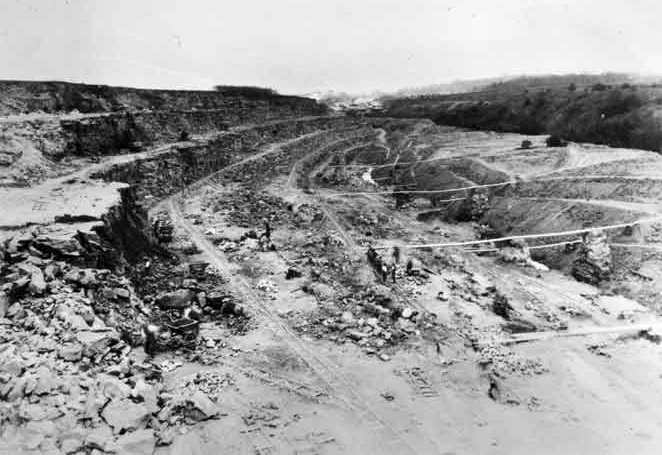
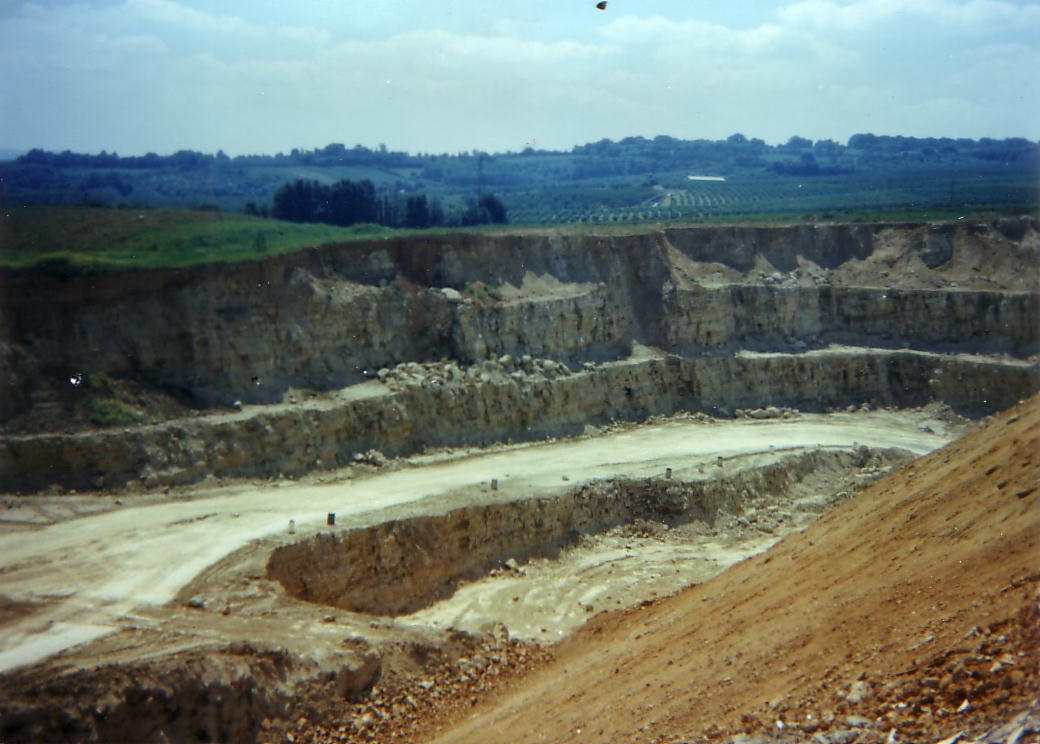
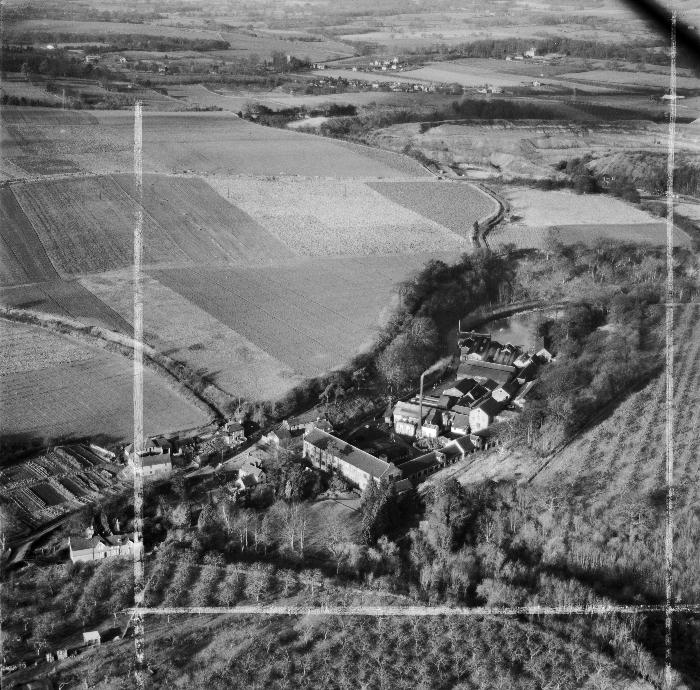
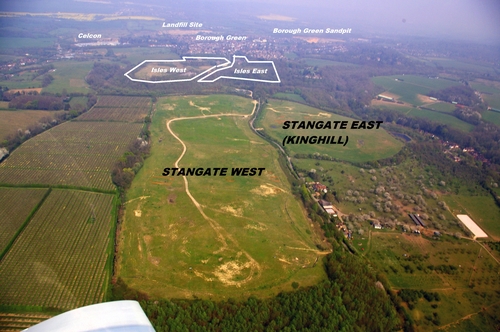
6.9 The CS identifies Isles Quarry West as a strategic housing allocation. The
site is a former quarry and latterly a landfill site. It lies within the Green
Belt and the AONB. There are two areas which benefit from certificates of
lawful use or development for industrial and related activities. From the
evidence before me, and what I was able to see on my site visit, there
would appear to be potential for some intensification of existing uses which
would not require planning permission. The Employment Land Review
(RD7.4) concludes that this site performs poorly in qualitative terms, and
classified it as an ‘other local' site with potential for release. The loss of the
employment potential of the site would not, therefore, have an
unacceptable impact on the strategy for employment land.
6.10 Vehicular access to the area can currently be gained either via Quarry Hill
Road, a predominantly residential road, or along a private road, known as
the haul road. Whether or not the owners of the haul road would continue
to maintain it in the future is a matter of conjecture. However, given the
length of the road compared to the amount of industrial land available, I
can understand the concerns expressed over the viability of retaining it in
the long term. Without it, vehicular traffic to Isles Quarry, including heavy
goods vehicles, would use Quarry Hill Road. The nature of the uses, and
their lawful status, would make it very difficult to control this activity, either
through planning or highways legislation. Development of the site for
housing would significantly reduce the number of heavy goods vehicles
visiting the site. It would also offer the opportunity for a comprehensive
approach to the management of the highway network in the vicinity, so as
to minimise the impact of traffic generated by the housing development.
6.11 It is to be expected that a site such as this would have some ground
contamination. There is nothing before me to suggest that the site could
not be remediated in accordance with current good practice. Other
constraints, such as any ecological value of the site are matters that will
need to be taken into consideration as more detailed plans are developed. I
do not consider the site to be poorly related to the centre of Borough Green.
I found the walk between the site and the village centre, via Quarry Hill
Road to be a pleasant route. As its name suggests the road is on a
gradient, but I do not consider it would be unduly daunting for most people.
It would be expected that measures to promote sustainability, such as cycle
routes and enhanced bus services, would form part of a package of
development proposals.
6.12 In between the industrial sites, the land has been restored, although the
standard of restoration would not be regarded as an example of current
best practice. Even if further restoration could be achieved, the presence of
the industrial uses would limit the overall effectiveness of such measures.
Therefore, whilst the non-industrial parts of the site fall outside the
definition of previously-developed land (Annex C PPS3), I consider the
description of the site as derelict and despoiled (CS paragraph 6.3.34) to be
an accurate reflection of the visual quality of the site as a whole. The
Tonbridge and Malling Core Strategy DPD Examination - Inspector's Report 2007
17
topography of the surrounding area means that the site is well screened in
views from the surrounding countryside. Bearing in mind the generally poor
landscape quality of the site, I consider that the proposed development
would have a broadly neutral impact on the natural beauty of the AONB.
6.13 The Council considers the site is capable of producing about 200 houses,
40% of which would be required to be affordable, under the terms of Policy
CP18. This would provide a relatively small proportion of the total
requirement for affordable housing in the Malling rural area identified in the
HMNA. However, I consider it would make a meaningful contribution.
6.14 Borough Green is encircled by the Green Belt, and there is no evidence to
suggest that sites of a substantial size within the village confines are likely
to come forward for development during the Plan period. Therefore, any
sites which could make more than a minimal contribution to affordable
housing will almost inevitably be located in the Green Belt. However, as I
indicate above, the site is well screened from the surrounding countryside,
which would help to minimise the visual impact of the loss of openness. I
do not consider that the gap between Borough Green and Ightham would be
unacceptably compromised.
6.15 It is the demonstrated need for affordable housing in the Malling rural area
which has led to the formulation of Policy CP19. The CS indicates that cross
subsidy with market housing is necessary to make the overall development
viable, and there has been criticism that the evidence base does not fully
justify this assertion. I have some sympathy with this view, as there is no
development appraisal or similar information before me which would enable
me to reach a reasoned view on this point. However, I am mindful of the
Government's policy objective to create a mix of housing, both market and
affordable (paragraph 10 PPS3). The development of sites of any
substantial size for affordable housing alone is likely to lead to a
concentration of such housing2, which would not fulfil that policy objective.
6.16 In this context, I consider that the details of the development economics of
the site, which can change over time, are less important than an indication
that the provision of a proportion of affordable housing, in accordance with
the Council's general aspirations, will be achieved. The site owners have
indicated to the Council that this is the case, and there has been some
scrutiny of this by the Council's valuers. On balance, I am not persuaded
that the lack of a detailed justification on the cross subsidy point renders
the CS unsound.
6.17 The provision of affordable housing is an important factor, but I consider
that it is the range of benefits that would be achieved, arising from the
particular circumstances of this site, which together constitute the
exceptional circumstances necessary to justify the alteration of the Green
Belt boundary. The proposed revised boundary of the Green Belt, as shown
on the Proposals Map, does not at present follow any clear features.
2 A clear indication of the Secretary of State approach to this matter can be found in a recent appeal decision which
forms RD7.27
Tonbridge and Malling Core Strategy DPD Examination - Inspector's Report 2007
18
However, the development of the site would offer scope to create a clear
boundary.
6.18 The general location of the site is shown in diagrammatic fashion on the key
diagram which forms part of the CS. Revised Borough Green village
confines are also identified in an Annex to the CS and the site is shown on
the Proposals Map. Paragraphs 2.9 - 2.14 of PPS12 give guidance on the
content of a CS, and further guidance on key diagrams is given in Annex A
of that document. Whilst paragraph 2.12 states that core strategies should
not identify individual sites, paragraph 2.13 and Annex A give examples of
where CS polices and proposals will need to be identified on an Ordnance
Survey base Proposals Map.
6.19 Bearing in mind the national importance attached to the Green Belt, I
consider that proposals to alter the boundary can be appropriately included
in the CS. In circumstances such as Isles Quarry West, the altered Green
Belt boundary has the effect of identifying a site for development.
Furthermore, the CS should not leave difficult decisions to later DPDs. The
delivery of affordable housing is an important element of the CS and in the
context of the Malling rural area, this site can reasonably be regarded as a
strategic allocation. In all the circumstances, I do not consider that the
approach taken to the identification of the Isles Quarry Site in the CS is
inconsistent with the advice in PPS12.
6.20 Some criticism of the Isles Quarry West proposal comes from those
promoting sites which they consider to be preferable. In some cases, these
sites may be closer to some facilities, may be developable more quickly, or
may be subject to fewer planning policy restraints, although all those near
Borough Green are within the Green Belt. None, in my view, would offer
the package of benefits that could result from the Isles Quarry
development, as outlined above. I have carefully considered the points
made, but there is no site (or sites) so clearly preferable in overall terms to
the Isles Quarry West proposal, such as to convince me that the CS is
unsound. In particular, I am not persuaded that harm to the purposes of
the Green Belt would necessarily be minimised by developing a smaller site
for affordable housing only. The level of harm that would arise depends not
solely on the size of the area. For example, the loss of a relatively small
area of land where the Green Belt is narrow could be more harmful than the
loss of a larger site in other circumstances.
6.21 I have considered the points raised by local residents and others who
oppose the development of this site. However, for the reasons I have
given, I find the CS to be sound.
Conclusions
6.22 In summary, I find the CS to be sound in relation to the general strategy for
the provision of affordable housing and the identification of a site at Isles
Quarry West to assist in meeting the needs of the Malling Rural Area. I
consider that the tests of soundness are met, having particular regard to
tests 4, 7, 8 and 9.